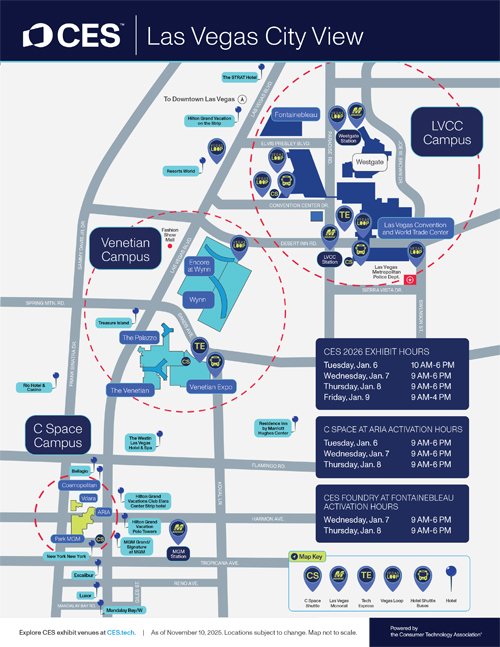
I've been to CES before, but this year, stretching across twelve venues along the Strip, put its true scale into perspective. What I didn't anticipate this year was how much the experience itself has changed. CES 2026 wasn't just bigger, it was more controlled. Long lines were no longer just about crowd size, but security. Attending keynotes now meant navigating badge re-issuance, metal detectors, and multiple screening checkpoints, often after standing in line for extended periods. These added layers fundamentally altered how I moved through the show and, more importantly, what I could realistically see. CES has always demanded tradeoffs, but in 2026, those tradeoffs were shaped as much by security logistics as by content.
CES has been getting bigger every year, but CES 2026 felt different. Not just larger - structurally different. Instead of being defined by consumer gadgets, CES is now unmistakably a global enterprise, industrial, and AI-driven business platform. The expansion into new venues like the Fontainebleau, now home to Quantum and AI programming, made that shift impossible to miss. This wasn't a show about what's cool. It was about what's being deployed at scale.
The Numbers Tell the Story
CES 2026 drew more than 148,000 industry professionals, including over 55,000 international attendees, reinforcing its role as a global business convening point.
The top participating countries by headcount underscored a major geographic shift:
- United States
- South Korea (14,405+)
- China (10,542+)
- Japan (6,426+)
- Canada (4,013+)
- Germany (2,623+)
More than 55% of attendees were senior-level executives, and over 60% of Fortune 500 companies were represented. This wasn't an audience browsing, it was an audience buying, partnering, and planning.
Asia's Expanding Influence
One of the most noticeable changes in 2026 was the surge of exhibitors from Asia, particularly in robotics and artificial intelligence. Humanoid robots, AI-powered consumer devices, and advanced automation platforms were everywhere.
Walking the floor, it was clear that innovation leadership is no longer geographically concentrated. Asia's presence, especially from South Korea, China, and Japan, shaped both the tone and the ambition of the show.
The Floor Plan Reflected the Shift
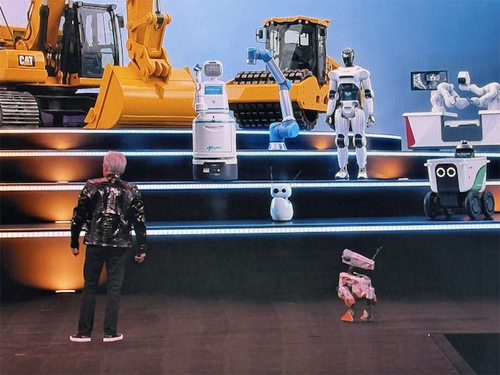
One massive hall was devoted entirely to industrial and infrastructure technology, autonomous vehicles, heavy machinery, and large-scale systems from companies like John Deere and Caterpillar. This was pure B2B. The audience skewed overwhelmingly male and heavily Asian, with surprisingly limited representation from India given its growing tech footprint.
Eureka Park, the startup and innovation halls felt more balanced, roughly 70% consumer, 30% B2B, and retained the exploratory energy CES is known for.
Meanwhile, the Quantum and AI conference area was unapologetically corporate. With NVIDIA, and industrial robotics leaders dominating the agenda, this was 100% enterprise. Business attire was more prevalent than casual dress. Sessions centered on scale, throughput, and competitive advantage. Other halls reinforced the pattern:
- Services and manufacturing: entirely B2B
- Accessories and holographic tech: a hybrid of consumer experiences and enterprise applications
Overall, CES now feels like a 50/50 split between consumer and B2B, but the money, seriousness, and long-term impact clearly sit on the enterprise side.
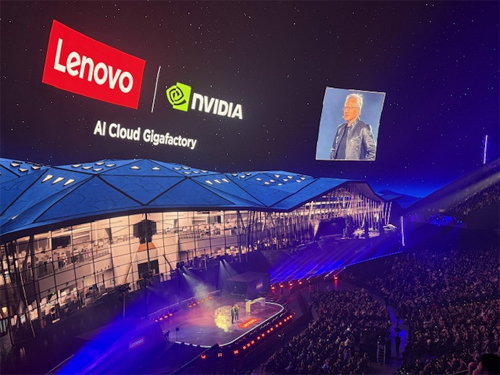
Lenovo Took Over the Sphere
One of the most memorable moments of CES 2026 was Lenovo Tech World at the Sphere. Yuanqing Yang, Chairman and CEO of Lenovo, delivered a fully immersive presentation focused on AI and real-world applications, joined by leaders from AMD, FIFA, Intel, Microsoft, NVIDIA, Qualcomm, and Sphere.
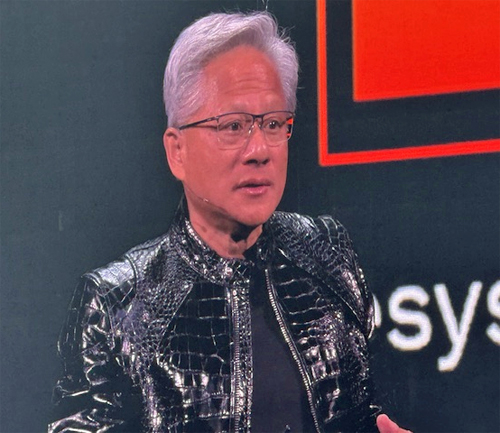
Jensen Huang, Three Times Over - and Still the Standout I heard Jensen Huang speak three times - during the NVIDIA keynote, the Siemens keynote, and the Lenovo event - and each appearance reinforced why he's one of the most compelling leaders in technology today.
NVIDIA's most jaw-dropping announcement was Vera Rubin, its new AI supercomputer rack. For you techies out there, here are the specs.
The Vera Rubin NVL72 rack integrates:
- 72 Rubin GPUs and 36 Vera CPUs
- 220 trillion transistors in a single unified system
- 260 terabytes per second of aggregate bandwidth - more bandwidth than the entire global internet
For context:
- Each Rubin GPU contains 336 billion transistors (up from Blackwell's 208 billion)
- Each Vera CPU contains 227 billion transistors
This level of bandwidth enables real-time data movement inside AI factories that previously required multiple racks or slower networking. It was one of the clearest examples at CES of how quickly AI infrastructure is advancing, and how far ahead NVIDIA continues to be.
NVIDIA and Mercedes: A Safety-First Moment Another standout announcement came from NVIDIA and Mercedes-Benz. During CES 2026, Jensen Huang and Ola Källenius detailed their jointly developed, AI-powered autonomous driving system, set to debut in the new Mercedes-Benz CLA production vehicles in the U.S. in Q1 2026. What stood out wasn't just the technology, but the emphasis on safety-first development. Hearing both CEOs speak candidly about validation, redundancy, and real-world testing left me feeling genuinely confident in the approach. It was one of the rare autonomous announcements that felt grounded, not over-promised.
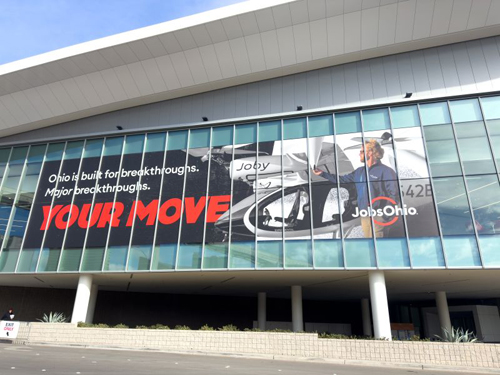
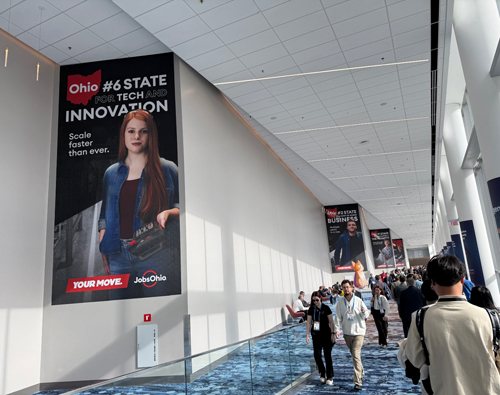
Ohio Made Itself Impossible to IgnoreOne unexpected highlight: JobsOhio.
Their presence was MASSIVE - large-scale banners and high-visibility branding throughout the show. Ohio wasn't quietly attending CES, but was asserting relevance on a global stage. I'm looking forward to seeing the results of this investment.
The Case Western Reserve University startups, both student- and alumni-led, were very impressive. Ironically, it took a trip to Las Vegas to meet some of them. (editor note - Nikki is a CWRU alum)
The Only Real Downside: Logistics
Logistics remained the most consistent challenge. With CES now spread across more venues than ever, moving between nearby hotels and different halls routinely took 30-40 minutes, whether on foot or via shuttles, rideshares, or even Zoox, Amazon's autonomous taxi service being tested in limited areas. I skipped the content and marketing conference at the Aria entirely, not for lack of interest, but because CES now demands strategic tradeoffs.
Final Takeaway
CES 2026 wasn't just about gadgets. It was about infrastructure, intelligence, and industry at scale.
Despite the logistical headaches and security lines, CES remains unmatched in its ability to reveal where technology is actually headed. And increasingly, that direction points toward enterprise deployment, global competition, and AI-driven transformation.
CES is no longer just a consumer tech show. It's a mirror of the global technology economy and who's leading it.
Nikki DiFilippo is President and CMO of Via Vera Group B2B Marketing and Strategy Consulting for MedTech and SaaS
We hope you will sign up for our free weekly eNewsletter which focuses on Ethnic and Cultural events and information. It arrives every Tuesday and you can sign up here.
Top of Page
Back to Great Lakes Geek Events |